The Café Terrace and Its Goddesses is a harem comedy that focuses on the theme of a found family. Spoilers ahead for both the anime and manga, by the way. Hayato Kasukabe returns to Miura to close his recently deceased grandmother’s cafe, Cafe Terrace Familia. But he discovers his grandmother had taken in five women who also worked the cafe. Each of the girls also refer to her as their grandmother and have become a family. Each of the girls have differing reasons to turn away from their own families and to create one with each other and under Hayato’s grandmother. To honor this, Hayato decides to keep the struggling cafe open.
Refreshingly, all of the women, except for the childish martial artist Ami, are adults in their late teens and early 20s. Their reasons to escape their biological family and their pasts weave into the present antics. And, as this is a harem, each of the young girls fall in love with Hayato and vie against each other to be picked as his wife. Except for Ami, anyway. Ami more loves him like an older brother, if in a “you can massage my boobs to help you feel better” anime-trope way. But in her defense, she is like that toward her adoptive sisters too.
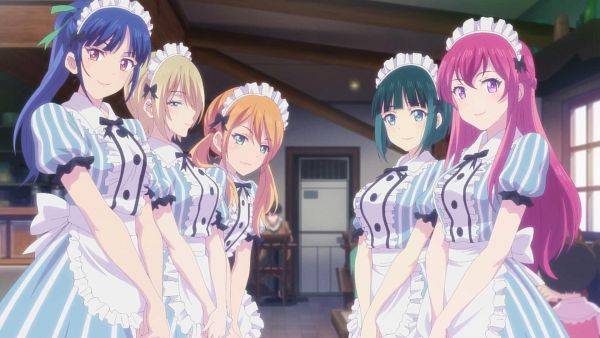
Because the story is a harem, I knew the story would teem with fan service. That fan service helped and hindered the story in equal measure. Some of it aimed at character development and character vulnerability. Other scenes hit on the usual harem beats. While the anime censors the nudity, this censorship matches the manga’s art.
Anyway, the story explores each of the girls’ histories and personal difficulties with Hayato working as the supporter. Hayato cares about each of them, but he believes people should make their own decisions. For him, family is as much about stepping back and offering support when needed as much as it is about being involved. Losing his parents at a young age and his regret for how he treated his grandmother stick with him. This regret and appreciate grows when he learns his grandmother gave up her career as a Michelin star chef to raise him. He isn’t dense about the girls’ affection for him–there’s no way anyone could be with how assertive they are–but he does waffle as harem protagonists tend to do. He cares for all of them and fears picking one would hurt the others. Each of the women are also the granddaughters of the cafe’s original workers. Hayato’s grandfather had married one of those workers, and Hayato closely resembles his grandfather. Speaking of the women:
Ami is the lone high schooler of the crew. She likes to wear masks and prank everyone, including customers. But under her sunny exterior, innocence, and airheadedness sits a deeply feeling character. This shows up during her character arc involving her grandmother, who cannot remember Ami. Ami, like Hayato, has only her grandmother as a relative. Because Hayato resembles his grandfather, he uses that to shock Ami’s grandmother enough to return her memory.
Ouka is the tsundere of the group. Her character arc includes her twin sister, Kikka, and Ouka’s worry about putting too much pressure on Kikka. Ouka decided not to go to university and study at a fashion school instead. Kikka takes on their parents’ expectations and goes to university.
Riho‘s past as a child actress and messy home life appears across a variety of episodes. Her mother tried to live vicariously through her, but when Riho failed to achieve fame, turned her back on Riho. Riho’s parents divorced when she was young because of their split on how to raise her, with her father promising not to reenter into Riho’s life until she’s 20 years old. Riho loves her mother but also resents her.
Shiragiku lived with Hayato’s grandmother the longest among the girls. Her father, a Michelin star chef who had studied under Hayato’s grandmother, arranges for Shiragiku (nicknamed Kiku-chan) to also study at the cafe. She originally struggles with cooking in her own style, wanting to preserve Grandmother’s menu and recipes, until Hayato convinces her that Grandmother would want her to do her own thing.
Akane comes from a rich, corporate-owning family and is the heiress. Her family disapproves of her love for music, how she works at a cafe, and how she is the vocalist and guitarist of a band. When Akane tells her grandmother of her feelings for Hayato, they both are kidnapped and brought before the matriarch so she can determine Hayato’s suitability for herself.
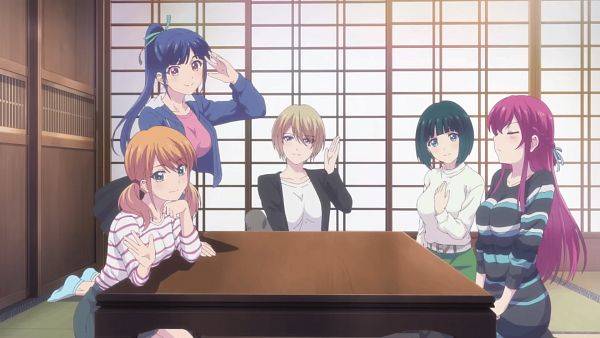
The found family theme is charming within this story. Each of the characters get along as sisters would, harem-dynamics aside. They argue and support each other as they grow together. Hayato, too, benefits from the found family. As an orphan, he learned to stand on his own, pushing most everyone away. The women form a familial net that he can’t escape, which helps him realize his need for family. Family has little to do with blood relations. Many of the girls have no true family ties with their blood relatives. Their bonds with each other are stronger. This story captures a trend among many people today who find and create their own families. Economics often force people to travel far from blood relatives. The Café Terrace and Its Goddesses, Samurai Champloo, and other stories remind us that blood isn’t as important as bond.
Hayato’s grandmother is also an interesting character in her absence. Her influence on all the characters shapes the family dynamics. Hayato often asks himself what she would do in a situation. The girls often reference her too. Her photo stands in a Buddhist shrine, overlooking their dinners and antics, with a soft kind smile. Each of the characters often reference her, showing the lasting, positive influence a person can have. Hayato’s grandfather is even more distant. But if it wasn’t for him, the characters wouldn’t have connected as they do. The threads connecting the characters and their grandparents across time creates a tidy mirrored circle. This sort of writing structure helps make a story feel more complete.
Spoilers below!
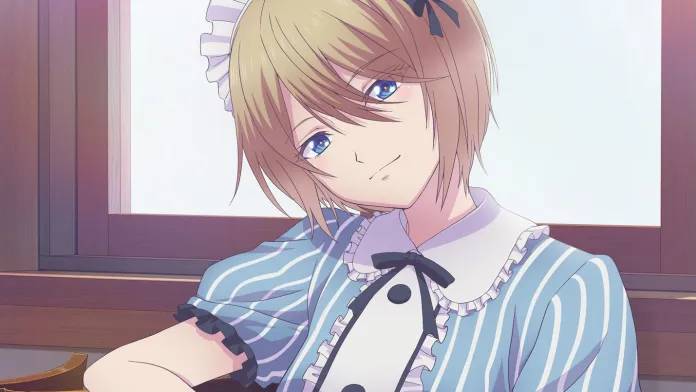
I make all of this sound more serious than it really is. This is a harem comedy at the end of the day. But these story dynamics kept me interested when I would’ve likely dropped it otherwise. As for who Hayato ends up marrying, the anime leaves you hanging. Typical harem in that way. You have to turn to the manga for that answer. I did warn about spoilers at the start of this article, so I will go ahead and tell you: Akane. She seems to be a good fit for Hayato’s personality. Of course, this being a harem, the manga ends with all the girls still doing their thing despite Akane and Hayato’s marriage.
The Café Terrace and Its Goddesses story kept me interested despite all the harem antics and humor that wasn’t to my taste. The harem genre’s tropes and beats are not what I prefer, but I can tolerate them for a decent underlying premise. The harem genre can be decent at found-family, growing-together stories. Harem fans will have enough to enjoy with the character dynamics.