
Suzume released in 2022, and I only got around to watching it in 2025. You might be surprised to learn that I don’t watch cinematic, stand-alone anime films all that often. I find it hard to cordon two hours to watch a single film. I don’t watch live-action films for the same reason. I’m bad about multitasking–writing or taking research notes–while I “watch.” Like you, I suffer from a focus deficit. I can watch a 20 minute anime episode with focus, even two or three, before I feel driven to get into a project or book or video game. Watching is a bit too passive. But sometimes I will make myself sit for two hours to watch a film. Suzume was one of these.
Makoto Niitsu, better known as Makoto Shinkai, directs the film. He is also behind Your Name and Weathering with You. I enjoyed both films. Suzume carries a similar character design and painterly art style as these films. The countryside is shown as a place of wonder, mystery, and beauty with almost-forgotten ruins playing a role in the story. The contrast of these ruins–modern areas abandoned because of landslides and other natural disasters–against the beauty of nature illustrates the idea of wabi-sabi. Wabi-sabi is an aesthetic focused on a melancholic, calm solitude. Ruins slowly being engulfed by nature elicit this feeling. Suzume doesn’t focus on this, but the environments belie the threat which lurks under them in the form of supernatural forces in the shape of giant earthworms.
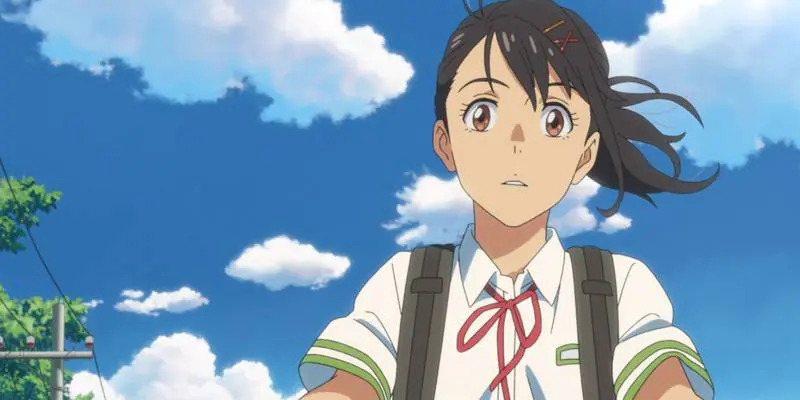
Suzume centers on the film’s namesake character coming-of-age and falling in love as she works to right her mistake. One day, she encounters a stranger, Souta Munakaka, on her way to school. He asks about the location of some local ruins. Curious about why the young man would be interested in ruins, she follows him. In the ruins, she encounters a strange free-standing door. She opens the door to discover a starlit field like the one she had seen once before as a child, but she can’t enter the field. Near the door she finds a cat statue stuck into the floor. After she frees the statue, it comes a real cat and flees. She soon learns that by opening the door and pulling out the cat statue from the ground, she has freed a supernatural force which causes earthquakes. Souta is a “Closer,” someone who locates doors like the one Suzume opens and closes them to keep the worm trapped and unable to create severe, damaging earthquakes. Their adventure across various locations in Japan to correct Suzume’s mistake leads Suzume to face her past and gain a clearer vision of how the world works.
Suzume is a road story, similar to Samurai Champloo. Characters travel to new locations as they pursue their goal, and plot events happen in each location. The story template allows writers to show a variety of different locations and keeps the story moving forward. In Suzume, the road story becomes a point of character conflict between Suzume and her aunt–who is her adoptive mother–who believes Suzume is running away with a guy. She’s not entirely wrong. Suzume and Souta’s story develops toward the beginning of a romance rather than a defined relationship as usual for these types of stories. A bit of a spoiler, perhaps, but really who can’t see a bit of romance developing in a story like this? The plot only sets the beginning of their romance rather than pushing the relationship toward a definitive “they will be together” story beat. Originally, Makoto wanted the story to be about Suzume and another girl traveling: “Why I even wanted to go in that direction in the first place is because I personally felt a little bit tired of telling the very traditional romance story.” He wanted a sisterhood story rather than a romance, but his producer told him that the audience wasn’t tired of romance (Baron, 2023). Honestly, I don’t think it that’s possible–look at the endless supply of Harlequin books and Hallmark films! So to avoid the romance dominating the story, Makoto decided to transform Souta into a three-legged chair.
Suzume uses many cinematographic techniques, such as blurring the background (focal depth) to emphasize elements. The lighting, in particularly, enhances the presentation, such as how light playing on water creates lens flares. The composition of scenes also stands out.
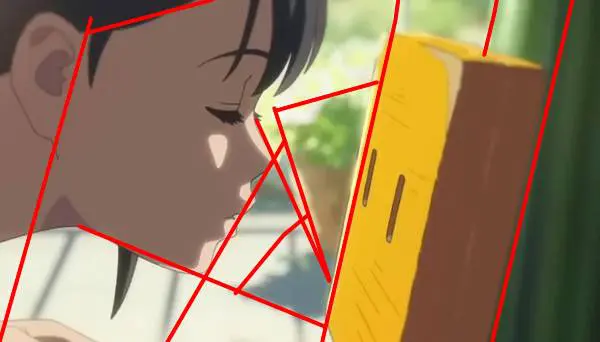
The red lines point to how the elements of this scene work together. First, on the right side, you have Souta and the simplistic background creating a contrast to the more complex center background and the complexity of Suzume’s face. The blurred potted plant in the background creates a triangular shape which emphasize Souta’s carved, open eyes locking with Suzume’s closed eyes. Suzume’s ear line creates a near parallel line with Souta’s side of the frame. Her mouth line leans toward Souta, creating another triangle within the center of the frame. The potted plant’s shadow connects with her chin’s line which connects with the far corner of Souta’s “face”, completing a parallelogram aimed at the area Souta’s mouth would be.
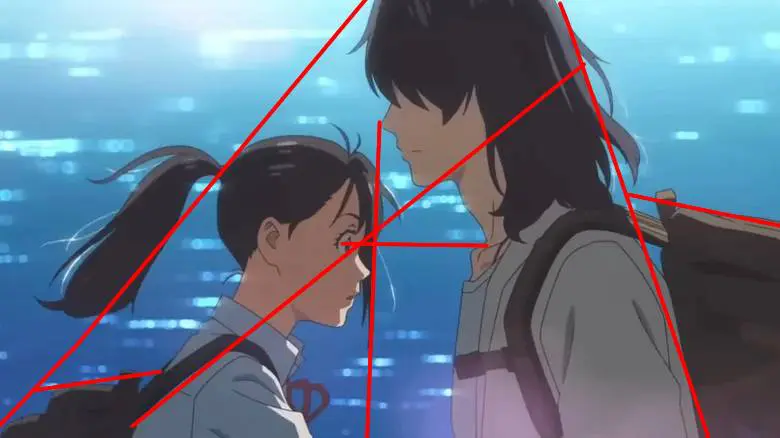
Let’s look at another example.The scene is a good example of the water lens effect. In this scene, Suzume passed behind Souta. Souta has his hair down, covering his eyes. Suzume’s equally long hair is up in a ponytail. The composition has a triangular design with Suzume’s angle moving toward Souta, foreshadowing how she moves toward him throughout the story. Their noses meet on the same plane. The angle of Suzume, including her backpack lends dynamism to the scene, against Souta’s less-forward moving motion. Her eyes align with his throat as she passes. Her eyes are uncovered, open to the future, while his are covered. He looks inward toward his problem as a Closer.
You can see compositions like these throughout the film. The film is a sight! But the CGI graphics of the cosmic earthworm felt out of place in several scenes. It would’ve been better to have 2D animated the force, but the off-look of the force also works from a storytelling perspective: the worm isn’t meant to be in their world, after all, and few can see it.
Suzume is an entertaining watch with compositions which jump off the screen and an enjoyable story which sidesteps a romantic focus. If you enjoyed the style and method of Your Name and Weathering With You, there’s more of the same to like here. Pausing these films in random scenes often reveals interesting, subtle compositions which point toward the character’s inner thoughts and concerns. Art is powerful in this way, even when you aren’t aware of the techniques. They build toward a vibe, a feeling and a connection, with the characters and story that once you learn to see lend to more enjoyment, or, when they are missing, understanding why you don’t enjoy a story. Suzume offers many examples of how composition can be used well.
References
Baron, Reuben (2023) Director Makoto Shinkai On The Anime Artistry Of Suzume – Exclusive Interview. Looper. https://www.looper.com/1254434/director-makoto-shinkai-anime-artistry-suzume-exclusive-interview/


Thank you for the thoughtful reply. The term parasocial relationship has long been used in Western media studies, but it doesn’t quite fit the dynamics seen in Japan.
In practice, the relationships between idols and fans are usually experienced as reciprocal and socially real. Idols often talk about “making memories together,” being moved by letters and words of support, and remembering individual fans by name. Fans, in turn, describe their involvement as supporting or walking alongside the idol’s growth — an emotional exchange that’s mutual, not imagined.
These interactions are better understood as ongoing communities of care and shared experience. As scholarship becomes more globally aware, it might be worth re-examining how such relationships are framed beyond the Western notion of the one-sided “parasocial.”
Thanks for the perspective! I’ve begun to dig into the academic literature surrounding idol culture (thanks for the idea to look at the positive side!). There’s an admitted dearth of literature, but what I have found so far is interesting. Each culture experiences idol culture in different ways. The West is largely parasocial in its experience. China appears to be someplace between what you describe and the Western parasocial experience. South Korea appears to a bit closer to what you describe than China. It’s interesting how the experience falls along a spectrum, at least so far in my foray.
I really appreciate that you took the time to explore Suzume’s visual language and story.
For me, this film means something very personal. I watched it after my favorite idol shared her thoughts about it on social media, and somehow it became more than just a movie — it felt like an experience we shared, quietly and from afar. I remember sitting after the credits, feeling that tender stillness that stays with you when something beautiful ends.
That’s one of the reasons I love Japanese art so deeply. It often connects people in small, almost wordless ways — through warmth, through beauty, through a sense of being alive together in the same fleeting moment. Suzume reminded me of that.
There’s a lot of research surrounding parasocial relationships. The phrase has taken on negative connotations in everyday discussions, but in academic literature parasocial relationships are seen as a natural process of the mind. They can be good or bad, depending on the person and the target. The target can be an idol, an actor, or a character in a novel. Your comment made me think of the good side of the research, fostering a sense of connection, belonging, and warmth as you describe.